
Controverscial.Com

Welcome

Jessie
Wicker Bell
(Lady
Sheba)

Written
and compiled by George Knowles
Jessie
Wicker Bell or “Lady Sheba” as she is better known, was the founder of
the “American Celtic Wicca Tradition” and the “American Order of
the Brotherhood of the Wicca”, through which she atempted to bring
differing covens, groups and traditions together working for the same aims, to
bring back the respectability
and acceptance of the Craft and a renewed belief in the Old Religions.
Controversially she was also the first person to publish a
complete “Book of Shadows” and make it available to the general public.
Born
on the 18th July 1920 in the mountains of Knott
County, Kentucky, Jessie came from
an Irish background on her maternal side, and a Native American background on
her paternal side; her great grandfather was a Cherokee Indian.
She claimed that her family had practised witchcraft for 7 generations,
and that she had led many previous lives. Her
own grandmother introduced her to craft when she was just 6 years old and taught
her the lore of the Irish Fairy Folk and the Spirit Guides of the Cherokee.
She also claimed to have inherited psychic abilities and been granted the
“Hand of Power”, which enabled her to protect others.
In
the late 1930’s Jessie was initiated into a
local witches coven and took the name Lady Sheba.
The name she claimed came from an inner awareness of a name she had once
been called in former life. After
getting married in the early 1940’s she devided her time between practicing
withcraft and raising four sons and four daughters.
The family moved to the Twin Cities (Saginaw and Bay City) area of
Michigan sometime around 1950, and there she founded her own coven, which
evolved into the “American
Celtic Wicca Tradition” and was based on the practices of her own Celtic
family heritage.
As
the tradition evolved and coven hived off coven spreading across the United
States, and indeed overseas, individual covens began to take on influences and
practices gained from other traditions such as Gardnerian, Alexandrian and
British Traditional Witchcraft. As the number of her covens grew,
each taking on its own individual form and working practices, Lady Sheba founded
another tradition under which they could all work together for unified ends, the
“American Order of
the Brotherhood of the Wicca”.
In
1970 Lady Sheba claimed she was directed by the Goddess to have
her personal “Book of Shadows” published, and to make it available to the
public for the benefit of the people. Following
her instincts she contacted Carl
“Llewellyn”
Weschcke in St Paul, Minnesota,
who by that time had
established his “Llewellyn Publishing Co.” as
the leading publisher of Occult and New Age books. Weschcke
invited Lady Sheba to visit him in St. Paul, where after seeing the manuscript
and signing a contract, he published her first book as the “Book
of Shadows” in 1971.


Carl
"Llewellyn" Weschcke - The
Book of Shadows
(ISBN
0-87542-075-3)
Book
Contents include:
Secret
initiation rites
Laws of the Craft (162 total)
Eight ceremonies for the Sabbats
Consecration rituals
Invocations
Actual chants and dances for calling on the gods
Lady
Sheba always claimed it was the will of the Goddess that directed her to have
the Book of Shadows published, in that it would “benefit of the people”.
That it did, for it was the
first Wiccan Book of Shadows
ever published in the United States. At
a time when there was very few book about witchcraft available, and due to the
secrecy surrounding the craft in those days, the only way anyone seeking
information about the craft was by word of mouth or by joining a coven (if one
could find one). The publication of Lady Sheba’s Book of Shadows for the
first time revealed the secret ritual workings of a traditional witch.
The
amount of press publicity generated throughout the late 1950’s and 60’s had
created a genuine resurgence of interest in Witchcraft and the Occult, but by
the early 1970’s in America, there were still far more people interested in
the Craft than there was people practising it, or experienced covens willing and
able to teach it. As such Lady
Sheba’s Book of Shadows became the template upon which many new covens and
traditions were formed, and quickly became a classic best seller in its own
time. Later in 1972
the “Book of Shadows” was republished and included in her second book
as “The Grimoire of Lady Sheba”.

The
Grimoire of Lady Sheba
(ISBN
0-87542-076-1)
Book
Contents include:
The
Power: Description of the rules and requirements for correct, effective use of
witchcraft
The
Tools: How to make, consecrate and use magickal instruments
The
Language: Includes diagrams of the lost Theban script and Runic alphabet
The
Rituals: Complete instructions for performing rituals for every purpose
The
Recipes: The famous secret herbal lore of witchcraft, including ointments, teas,
incense, perfumes and oils
The
Dances: Traditional Square dances as well as magickal "Witches Rounds"
The
Book of Shadows: The Holy Book of Witchcraft
The
Eightfold Path: Describes the steps to magickal attainment.
In
1971 Lady Sheba initiated
Carl “Llewellyn”
Weschcke into
her coven of the “American
Celtic Wicca Tradition”, he
soon rose to become a High Priest working with his own coven at his Mansion
House home on Summit Avenue in St Paul.
That same year he met Sandra Heggum a High Priestess in
the same tradition, and later they married in a heavily publicized handfasting
ceremony. Following the first
publication of her Book of Shadows, Lady Sheba visited with Weschcke
and his wife regularly, and even participated as a guest speaker in the annual
“Gnosticon” festivals sponsored
by Weschcke in Minneapolis.
On
13th August 1971, Lady Sheba registered the “American
Order of the Brotherhood of the Wicca” in
Michigan as a legally recognised religion,
marking an important step towards the legal recognition of Wicca as a religion.
She also played an active part in the organization of the “Council
of American Witches” led by Weschcke in 1973.
As the elected chairman of the council, Weschcke
drafted the now famous “Thirteen Principals of Wiccan
Belief”. These
were a general set of
principles and definitions loosely found to be acceptable across the many
different traditions operating at that time in America.
The statement was later incorporated into the U.S. Army’s
handbook for chaplains, further helping to establish Wicca as a recognized
religion.
During
the early 1970’s Wicca and Witchcraft in America was still evolving, it was a
time when many new covens, groups and traditions were just starting up, and in
order to gain credibility, many of them tried to claim lineage to this or that
“founder” or “hereditary tradition”.
For whatever reason, the ethos of the day seemed to be “My tradition or
way is better than yours!!” As a
result, this started off a spate of name-calling and bitter recriminations.
The 1970’s are today commonly referred to as the “Witch War” years,
during which Lady Sheba attracted a great deal of criticism.
As
the founder and figurehead of two growing traditions the “American
Celtic Wicca Tradition” and the “American
Order of the Brotherhood of the Wicca”, Lady Sheba took on a self-proclaimed title and referred
to herself as the “American
Witch Queen”.
As happened to Alex Sanders as the “King of the Witches” earlier in the
1960’s, her use of such a grandiose title brought with it the scorn, ridicule
and criticism of many in the community. Such titles as “King or Queen”
hold connotations of the dogmatic hierarchical structures of other mainline
religions, the very thing most witches and pagans avoid, and why they prefer a
non-institutional Nature-based religion. Leaders
of the Craft are respected as Elders, no more and no less, regardless of their
personal accomplishments.
However,
perhaps the most serious criticism directed against Lady Sheba concerns the
publication of her “Book of Shadows”. Many
in the community felt she had violated some kind of “sacred oath” by breaking
the traditional vows commonly attached to a tradition’s Book
of Shadows. While some defended
her, many others vilified her, and even Doreen
Valiente one of Gerald Gardner’s early High Priestessess stepped into the
foray, claiming it contained material taken from the original Gardnerian
“Book of Shadows”, secret material that should never have been made public.
Other allegations followed that she had deliberately stolen the
Gardnerian material simply to embellish her own.
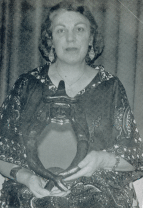
Doreen
Valiente
Such
allegations and criticisms directed toward Lady Sheba continued for a number of
years, so much so and to her bitter disappointment by the end of the 1970’s
she had withdrawn from public life
altogether. Her “Book of
Shadows” on the other hand was reprinted in a modified paperback form for the
mass market, and for a time was readily available in most major bookstores
before finally going out of print in the early 1980’s.
Nothing more was heard from Lady Sheba until Carl
“Llewellyn”
Weschcke decided to re-issue her book as a new millennium tribute. After extensive enquires
to her where a bouts, he eventually located her living with a daughter back in
their old home county of Kentucky. Having
gained permission “The Grimoire of Lady Sheba” was re-issued
in its original hardback form in June 2001.
Despite
all the ridicule and criticism she had suffered over it, Lady Sheba always
defended the publication of her “Book of Shadows”, and was proud of the way
it had helped to change the secretive and selective attitudes of the Craft in
the 1950’s and 60’s, to make the Craft more open and available to all in the
1970’s. During the late 1930’s
when Lady Sheba joined her first coven, she had hand-copied their Book of
Shadows for her own use, as was the traditional practise in those times. After which and over the following 30 years to 1970, she
continued to add rituals, spells,
recipes and other working practices gleaned from whatever sources freely came
her way, ending up with an eclectic mix of knowledge gleaned first and
foremost from her own family tradition, as well as knowledge gained from other
mainline traditions such as the Gardnerian and Alexandrian traditions.
The
book today should not be taken too seriously, as much of its content is dated by
today’s standards i.e. some of the old laws, rituals, recipes and practices
such as the use of the scourge, may even seem archaic, but the book should
never-the-less hold pride of place in the history section of a modern Pagan’s
library, as a snap shot reminder of just how much the practice of contemporary
witchcraft has evolved since those early days.
Lady Sheba died on the 20th March 2002, and as was her final
wishes, she was cremated
along with a copy of her “Book of Shadows” and the ashes scattered about the graveyard of the Wicker Family Cemetery
in Knott County, Kentucky.
Those
who knew Lady Sheba personally in the early pagan communities still speak highly
of her as a powerful and magical person, and one who will be remembered for her
many contributions toward the advancement of the Craft and the Old Religion.
Ultimately her two books the “Book of Shadows” and “The
Grimoire of Lady Sheba” were responsible for the growth of Wicca in
America, and are a fitting legacy to her belief in the Goddess.
End.
Sources:
Books
The
Encyclopedia of Witches &Witchcraft -
By Rosemary Ellen Guiley
The Encyclopedia of Modern Witchcraft and Neo-paganism - By Shelley
Rabinovitch
Websites
http://www.tylwythteg.com/obituary.html
http://www.paganwiki.org/index.php?title=Lady_Sheba
http://www.llewellyn.com/bookstore/article.php?id=236
Written
and compiled on the 29th February 2008
© George Knowles

Best
wishes and Blessed Be
|
Site Contents - Links to all Pages
Home Page
A Universal Message:
Let there be peace in the world - Where
have all the flowers gone?
About me:
My Personal Page /
My
Place in England, UK / My Family Tree (Ancestry)
Wicca & Witchcraft
Wicca/Witchcraft
/ What is Wicca / What
is Magick
Traditional Writings:
Wiccan Rede / Charge
of the Goddess / Charge
of the God / The
Three-Fold Law (includes The Law of Power and The Four Powers of the Magus)
/ The Witches Chant /
The Witches Creed / Descent
of the Goddess / Drawing
Down the Moon / The
Great Rite Invocation / Invocation
of the Horned God / The
13 Principles of Wiccan Belief / The
Witches Rede of Chivalry / A
Pledge to Pagan Spirituality
Correspondence Tables:
Incense /
Candles / Colours
/ Magickal Days / Stones
and Gems / Elements and Elementals
Traditions:
Traditions Part 1 - Alexandrian
Wicca / Aquarian Tabernacle Church (ATC)
/ Ár Ndraíocht Féin (ADF) /
Blue Star Wicca / British
Traditional (Druidic Witchcraft) / Celtic Wicca /
Ceremonial Magic / Chaos
Magic / Church and School of Wicca /
Circle Sanctuary / Covenant
of the Goddess (COG) / Covenant of
Unitarian Universalist Pagans (CUUPS) / Cyber
Wicca / Dianic Wicca /
Eclectic Wicca / Feri Wicca /
Traditions
Part 2 - Gardnerian Wicca /
Georgian Tradition / Henge of Keltria
/ Hereditary
Witchcraft / Hermetic Order of the
Golden Dawn (H.O.G.D.) / Kitchen
Witch (Hedge Witch) / Minoan Brotherhood and Minoan Sisterhood Tradition / Nordic Paganism / Pagan Federation / Pectic-Wita / Seax-Wica / Shamanism /
Solitary / Strega / Sylvan Tradition / Vodoun or Voodoo /
Witches League of Public Awareness (WLPA) /
Other things of interest:
Gods and Goddesses (Greek
Mythology) / Esbats &
Full Moons / Links
to Personal Friends & Resources / Wicca/Witchcraft
Resources / What's a spell? /
Circle Casting and
Sacred Space / Pentagram
- Pentacle / Marks
of a Witch / The Witches
Power / The Witches Hat
/ An
esoteric guide to visiting London / Satanism
/ Pow-wow
/ The
Unitarian Universalist Association / Numerology: Part 1
/ Part 2 / Part
3 / A
history of the Malleus Maleficarum: includes: Pope
Innocent VIII /
The
papal Bull /
The
Malleus Maleficarum /
An extract from the Malleus Maleficarum
/ The letter of approbation
/ Johann
Nider’s Formicarius /
Jacob
Sprenger /
Heinrich Kramer /
Stefano Infessura
/ Montague Summers /
The Waldenses
/ The Albigenses
/
The Hussites / The
Sun Dance
/ Shielding (Occult
and Psychic Protection) /
The
History of Thanksgiving / I
have a Dream, the 1963 speach by civil rights campaigner Martin Luther King
/ Auras by Graham Furnell - Part
1 and Part 2 /
Sabbats and Rituals:
Sabbats in History and Mythology /
Samhain (October 31st) /
Yule (December 21st) /
Imbolc (February 2nd) /
Ostara (March 21st) /
Beltane (April 30th)
/ Litha
(June 21st) /
Lughnasadh (August 1st) /
Mabon (September 21st)
Rituals contributed by Crone:
Samhain / Yule
/ Imbolc / Ostara /
Beltane / Litha
/ Lammas / Mabon
Tools:
Tools of a Witch
/ The Besom (Broom) / Poppets
and Dolls / Pendulums
/ Cauldron
Magick / Mirror Gazing
Animals:
Animals in
Witchcraft (The Witches Familiar) / Antelope
/ Bats / Crow
/ Fox
/ Frog
and Toads / Goat / Honeybee
/ Kangaroo /
Lion / Owl
/ Phoenix / Rabbits and Hares
/ Raven / Robin
Redbreast / Sheep
/ Spider / Squirrel
/ Swans / Wild
Boar
/
Wolf /
Serpent / Pig / Stag /
Horse / Mouse / Cat
Trees:
In
Worship of Trees - Myths, Lore and the Celtic Tree Calendar. For descriptions and
correspondences of the thirteen sacred trees of Wicca/Witchcraft see the
following: Birch
/ Rowan
/ Ash /
Alder
/ Willow
/ Hawthorn
/ Oak
/ Holly
/ Hazel
/ Vine
/ Ivy
/ Reed
/ Elder.
Also see: The
Willow Tree (Folk Music)
Sacred Sites:
Mystical
Sacred Sites - Stonehenge / Glastonbury Tor / Malta
- The Hypogeum of Hal Saflieni / Avebury / Cerne Abbas - The Chalk
Giant / Ireland - Newgrange /
Rocks and Stones:
Stones
- History,
Myths and Lore
Articles
contributed by Patricia
Jean Martin: / Apophyllite
/ Amber / Amethyst / Aquamarine
/ Aragonite / Aventurine
/ Black
Tourmaline / Bloodstone /
Calcite / Carnelian / Celestite
/ Citrine / Chrysanthemum
Stone / Diamond / Emerald
/ Fluorite
/ Garnet / Hematite /
Herkimer Diamond / Labradorite / Lapis Lazuli / Malachite
/ Moonstone / Obsidian
/ Opal
/ Pyrite
/ Quartz (Rock Crystal) /
Rose Quartz
/ Ruby / Selenite / Seraphinite /
Silver and Gold / Smoky Quartz
/ Sodalite / Sunstone
/ Thunderegg / Tree
Agate / Zebra
Marble
Wisdom:
Knowledge
vs Wisdom by Ardriana Cahill
/ I
Talk to the Trees / Awakening
/ The Witch in You / A
Tale of the Woods
Articles and Stories about Witchcraft:
Murder
by Witchcraft / The
Fairy Witch of Clonmel / A
Battleship, U-boat, and a Witch / The
Troll-Tear (A story for Children) / Goody
Hawkins - The Wise Goodwife / The
Story of Jack-O-Lantern / The
Murder of the Hammersmith Ghost / Josephine
Gray (The Infamous Black Widow) / The
Two Brothers - Light and Dark
Old Masters of Academia:
Pliny the Elder /
Hesiod
/ Pythagoras
Biographies
(Ancient,
Past and Present)
Remembered
at Samhain
(Departed
Pagan Pioneers, Founders, Elders and Others)
Abramelin
the Mage / Agrippa /
Aidan A. Kelly / Albertus Magnus
“Albert the Great” / Aleister
Crowley “The Great Beast” / Alex
Sanders "the King of the Witches” / Alison
Harlow / Amber K / Anna Franklin
/
Anodea
Judith / Anton Szandor LaVey / Arnold
Crowther / Arthur
Edward Waite / Austin
Osman Spare / Biddy Early / Bridget
Cleary / Carl
Llewellyn Weschcke / Cecil
Hugh Williamson / Charles
Godfrey Leland / Charles
Walton / Christina
Oakley Harrington /
Damh the Bard (Dave Smith)
/ Dion
Fortune / Dolores
Aschroft-Nowicki / Dorothy Morrison
/ Doreen
Valiente / Edward Fitch / Eleanor
Ray Bone “Matriarch of British Witchcraft” / Dr. John Dee and Edward
Kelly / Dr.
Leo Louis Martello / Eliphas
Levi / Ernest
Thompson Seton /
Ernest Westlake and the
Order of Woodcraft Chivalry / Fiona Horne /
Friedrich von Spee
/ Francis
Barrett /
Gerald
B. Gardner / Gavin
and Yvonne Frost and the School and Church of Wicca / Gwydion Pendderwen
/ Hans Holzer /
Helen
Duncan / Herman
Slater "Horrible Herman"
/ Israel
Regardie / James
"Cunning" Murrell / Janet
Farrar & Gavin Bone / Jessie Wicker
Bell “Lady Sheba” / John
Belham-Payne / John George Hohman
/ John
Gerard / John
Gordon Hargrave
(the White Fox) /
John
Michael Greer / John
Score / Johannes
Junius the Burgomaster of Bamberg / Joseph
John Campbell / Karl
von Eckartshausen / Laurie
Cabot "the Official Witch of Salem" / Lewis
Spence / Margaret
Alice Murray / Margot Adler
/ Marie Laveau the
" Voodoo Queen of New Orleans" / Marion
Weinstein / Matthew
Hopkins “The Witch-Finder General” / Max
Ehrmann and the Desiderata / Monique Wilson
the “Queen
of the Witches” /
Montague
Summers / Nicholas Culpeper
/ Nicholas Remy
/ M.
R. Sellers / Mrs.
Grieve "A Modern Herbal" / Oberon
and Morning Glory Zell-Ravenheart / Old
Dorothy Clutterbuck / Old
George Pickingill / Paddy Slade
/ Pamela
Colman-Smith / Paracelsus
/ Patricia
Crowther / Patricia
Monaghan / Patricia
“Trish” Telesco / Philip
Emmons Isaac
Bonewits /
Philip Heselton / Raymond
Buckland / Reginald
Scot / Robert
Cochrane / Robert ‘von Ranke’
Graves and "The White Goddess" / Rudolf
Steiner
/ Rosaleen
Norton “The Witch of Kings Cross” / Ross
Nichols and The Order of Bards,
Ovates & Druids / Sabrina
- The Ink Witch / Scott
Cunningham / Selena
Fox / Silver
Ravenwolf / Sir
Francis Dashwood / Sir
James George Frazer / S.L.
MacGregor Mathers and the “Hermetic Order of the Golden Dawn” / Starhawk
/ Stewart
Farrar / Sybil
Leek / Ted
Andrews / The Mather Family
- includes: Richard Mather, Increase
Mather, Cotton Mather / Thomas
Ady / Vera Chapman /
Victor Henry Anderson
/ Vivianne
Crowley / Walter Brown Gibson
/ William
Butler Yeats / Zsuzsanna
Budapest
Many
of the above biographies are brief and far from complete. If you know
about any of these individuals and can help with aditional information, please
cantact me privately at my email address below. Many thanks for
reading :-)
"FAIR USE NOTICE"
While I have taken due care and dilligence to credit all
sources where possible, this website may contain copyrighted material which has
not been specifically authorized by the copyright owner. My use of making
such material available here is done so in my efforts to advance our
understanding of religious discrimination, the environmental and social justice
issues etc.
If you wish to use copyrighted material from this wedsite for purposes of your
own then you must obtain permission from
the relevant copyright owner yourself.

Email_Witches
My online email discussion group:
http://groups.yahoo.com/group/Email_Witches
Dove of Peace
Help send a message
of peace around the world! The Dove of Peace flies from site to site, through as many
countries as possible. It does not belong to ANY belief system.
Please help make a line around the globe by taking it with you to your site, by
giving it to someone for their site, by passing it on to another continent or to
the conflict areas of the world. May trouble and strife be vanquished in
it's path.

Please
take time to sign my Guest Book.
mailto:George@controverscial.com
|
|