Controverscial.Com

Welcome

|
Controverscial.Com
Welcome
|
|
|
Controverscial.Com
Welcome
|



In
northern Europe, February was the traditional month of lambing. The
ewe’s milk came in before the time of giving birth and so we have the names,
Imbolc, “in the belly;” and Oimelc, “ewe’s milk,” as the names of the
festival we are celebrating at this time of year. What better time to look
at our friend, Sheep, as Totem.
Sheep
originated in Asia. We see them as totems in many early Asian
civilizations. Sheep has been included in the Chinese zodiac as well as the sign
of Aries in the Western zodiac. During the Stone Age, wild sheep were
hunted for their meat. Toward the end of the Stone Age, about 10,000 years
ago, sheep began to be domesticated. It is thought that this was because
the human population had grown to such an extent that having a flock of sheep
available provided a consistent source of both meat and milk, and was therefore
an efficient means for survival.
Early
sheep were hairy and didn’t have much wool. As time passed, humans began
to breed sheep with longer hair and eventually, about 3,500 BCE, the art of
spinning wool for thread and yarn evolved. Interestingly, sheep were
also being bred to be less intelligent than their predecessors so they would be
easier to manage and less likely to escape. Today’s sheep have smaller
brains than their ancient ancestors. However, as we shall see, they are
not as stupid as they are portrayed to be.
Sheep
were one of the earliest animals to be domesticated. Long has been the
relationship between sheep and humankind as evidenced by the intertwining of
sheep into various cultures, their religions and astrology. The trading of wool
and sheep products led to the first international trade. Today sheep
farming is a key industry for countries such as New Zealand, Australia, South
America and the British Isles.
Gregariousness,
or the tendency to gather in social groups of like kind, is a word commonly used
to describe sheep behavior. Sheep have strong flocking instincts. It
is this flocking instinct that causes them to stick together. It is much
more difficult to attack a sheep in a large group than it is a lone stray.
They also have an instinct to follow each other. It doesn’t matter
who’s leading. There is a story of a flock falling off a cliff to their deaths
because one random sheep decided to take a walk. They are a prey animal
and will run from what frightens them.
As
a prey animal, the sheep depends greatly on its senses for survival, relying
heavily upon its sense of sight. If it doesn’t keep other sheep in view
at all times, it will become upset and agitated. A sheep’s field of
vision ranges from 190-306 degrees with just a slight turn of the head.
Sheep can recognize and remember up to fifty sheep faces, and even human
ones, for years.
Sheep
have a keen sense of hearing and become frightened with loud noises. Their
sense of smell is highly developed as they can distinguish between their fellow
sheep and predators, another necessary defense mechanism. The rams use
their sense of smell to locate available females and the ewes use their sense of
smell to locate their young. The sense of touch is important for sheep.
Group animals stay close together and the sense of touching each other calms the
sheep. Lambs stay in close physical contact with their mothers.
Taste helps sheep to distinguish between food stuffs. They have been known
to choose foods that will make them feel better, a sort of self-medication.
Because
of their strong flocking instinct, and their flight response when threatened,
sheep are often thought to be unintelligent. This, however, has been
disproved. As previously mentioned, sheep have excellent memories. They
can also problem solve. It has been reported that they found their way
over a cattle grid to get to better food. They have also demonstrated the
ability to learn to navigate mazes.
Although mostly docile, sheep can be aggressive and dangerous. A male during rutting season, for example, will show aggressive behavior in an effort to dominate the flock. A ewe will show aggressive and protective behavior when their lambs are threatened.
Baby lambs love to play. They like to run, jump and climb on things. Their cousins in the wild, Big Horn Sheep, Cashmere Goats and Tibetan Sheep live and climb in the highest of mountains portraying a sense of loftiness and being sure footed.

Sheep
like their food. Often they are moved with enticements of food instead of
being herded with dogs. They are grazers, cud chewers, ruminants. By
definition, ruminants graze and regurgitate already chewed and swallowed food to
have another go at it.
Relaxation
is a key ingredient to feeding this way as opposed to the adrenalin rush
experienced by predatory carnivores during their hunt and kill. Rumination
also has another definition, one that was derived from the behavior of sheep,
which is to think at length, to contemplate, consider, study; to think deeply or
ponder; to reflect on over and over again.
When
Sheep enters your life, perhaps it is an indication that you have been dwelling
on an issue or situation too long and it is time to seek resolution and move on.
The other side of that coin to consider is that perhaps you may have been too
hasty in a decision or action and need to think deeply, ponder, study or
meditate more on a particular situation or issue.
Sheep can indicate balance in precarious situations, lofty ideals, perseverance, status and inspiration. When Sheep shows up, beware of going with the general flow. Look at all sides of the situation before making a decision. Don’t follow the flock off a cliff to your detriment.
However, there are times when there is safety in numbers, and when Sheep shows up, it might be an indication to identify your resources and allies and stick close by them to weather out whatever storm may be on the horizon. It may also be a time to think about developing a sense of community and cooperation.

Sheep
as Totem reminds us to use all of our senses, internal as well as external, and
our intellectual capacity as we go about our daily lives. Sheep reminds us
that staying calm and relaxed will help us to better digest, understand and
problem-solve what is put in front of us.
Sources:
http://en.wikipedia.org/wiki/Domestic_sheep#History
http://animalscience.ag.utk.edu/sheep/pdf/AppliedSheepBehavior-WWG-2-04.pdf
http://www.sheep101.info/history.html
http://www.alphadictionary.com/index.shtml
http://www.thewildlifetravels.com/sheep-goats-india-wildlife.html
http://www.sheep101.info/201/behavior.html
Sheep
herself
©
2009 Lillian Norman
Lil lives in northeast Ohio and is a solitary pagan
witch. She has been a member of EW since 2005.

"In
the past shamans, priests, and priestesses were the keepers of the sacred
knowledge of life. These individuals were tied to the rhythms and forces
of nature. They were capable of walking the threads that link the
invisible and visible worlds. They helped people remember that all trees
are divine and that all animals speak to those who listen."
There
is a shaman and priest or priestess in all of us. It is our job to realize
and reconnect to that fact. And it is through the expressions of Nature
that we can enhance and hasten the realization and reconnection.
"When
we see one aspect of the world with new eyes, we begin to see ourselves with new
eyes as well."
It
is very common during our celebrations of the Sabbats and Esbats, our Dedications
or Initiations, that animals will make themselves known. Animal Spirit understands
the sacred journey we are on, and comes to join us in celebration as we explore
and discover our truest selves. Many wish to impart their wisdom,
if we will but hear. Are you listening?
"Nature
teaches to those who will learn from Her."
©
Patricia J. Martin
All
quotations attributed to Ted Andrews:
Animal-Speak: the Spiritual & Magical Powers of Creatures Great &
Small

Let there be peace in the world - Where have all the flowers gone?
My Personal Page / My Place in England, UK / My Family Tree (Ancestry)
Wicca/Witchcraft / What is Wicca / What is Magick
Traditional Writings:
Wiccan Rede / Charge of the Goddess / Charge of the God / The Three-Fold Law (includes The Law of Power and The Four Powers of the Magus) / The Witches Chant / The Witches Creed / Descent of the Goddess / Drawing Down the Moon / The Great Rite Invocation / Invocation of the Horned God / The 13 Principles of Wiccan Belief / The Witches Rede of Chivalry / A Pledge to Pagan Spirituality
Correspondence Tables:
Incense / Candles / Colours / Magickal Days / Stones and Gems / Elements and Elementals
Traditions Part 1 - Alexandrian Wicca / Aquarian Tabernacle Church (ATC) / Ár Ndraíocht Féin (ADF) / Blue Star Wicca / British Traditional (Druidic Witchcraft) / Celtic Wicca / Ceremonial Magic / Chaos Magic / Church and School of Wicca / Circle Sanctuary / Covenant of the Goddess (COG) / Covenant of Unitarian Universalist Pagans (CUUPS) / Cyber Wicca / Dianic Wicca / Eclectic Wicca / Feri Wicca /
Traditions Part 2 - Gardnerian Wicca / Georgian Tradition / Henge of Keltria / Hereditary Witchcraft / Hermetic Order of the Golden Dawn (H.O.G.D.) / Kitchen Witch (Hedge Witch) / Minoan Brotherhood and Minoan Sisterhood Tradition / Nordic Paganism / Pagan Federation / Pectic-Wita / Seax-Wica / Shamanism / Solitary / Strega / Sylvan Tradition / Vodoun or Voodoo / Witches League of Public Awareness (WLPA) /
Gods and Goddesses (Greek
Mythology) / Esbats &
Full Moons / Links
to Personal Friends & Resources / Wicca/Witchcraft
Resources / What's a spell? /
Circle Casting and
Sacred Space / Pentagram
- Pentacle / Marks
of a Witch / The Witches
Power / The Witches Hat
/ An
esoteric guide to visiting London / Satanism
/ Pow-wow
/ The
Unitarian Universalist Association / Numerology: Part 1
/ Part 2 / Part
3 / A
history of the Malleus Maleficarum: includes: Pope
Innocent VIII /
The
papal Bull /
The
Malleus Maleficarum /
An extract from the Malleus Maleficarum
/ The letter of approbation
/ Johann
Nider’s Formicarius /
Jacob
Sprenger /
Heinrich Kramer /
Stefano Infessura
/ Montague Summers /
The Waldenses
/ The Albigenses
/
The Hussites / The
Sun Dance
/ Shielding (Occult
and Psychic Protection) /
Sabbats in History and Mythology / Samhain (October 31st) / Yule (December 21st) / Imbolc (February 2nd) / Ostara (March 21st) / Beltane (April 30th) / Litha (June 21st) / Lughnasadh (August 1st) / Mabon (September 21st)
Rituals contributed by Crone: Samhain / Yule / Imbolc / Ostara / Beltane / Litha / Lammas / Mabon
Tools of a Witch / The Besom (Broom) / Poppets and Dolls / Pendulums / Cauldron Magick / Mirror Gazing
Animals in Witchcraft (The Witches Familiar) / Antelope / Bats / Crow / Fox / Frog and Toads / Goat / Honeybee / Kangaroo / Lion / Owl / Phoenix / Rabbits and Hares / Raven / Robin Redbreast / Sheep / Spider / Squirrel / Swans / Wild Boar / Wolf / Serpent / Pig / Stag / Horse / Mouse / Cat
In Worship of Trees - Myths, Lore and the Celtic Tree Calendar. For descriptions and correspondences of the thirteen sacred trees of Wicca/Witchcraft see the following: Birch / Rowan / Ash / Alder / Willow / Hawthorn / Oak / Holly / Hazel / Vine / Ivy / Reed / Elder. Also see: The Willow Tree (Folk Music)
Mystical Sacred Sites - Stonehenge / Glastonbury Tor / Malta - The Hypogeum of Hal Saflieni / Avebury / Cerne Abbas - The Chalk Giant / Ireland - Newgrange /
Rocks and Stones:
Stones - History, Myths and Lore
Articles contributed by Patricia Jean Martin: / Apophyllite / Amber / Amethyst / Aquamarine / Aragonite / Aventurine / Black Tourmaline / Bloodstone / Calcite / Carnelian / Celestite / Citrine / Chrysanthemum Stone / Diamond / Emerald / Fluorite / Garnet / Hematite / Herkimer Diamond / Labradorite / Lapis Lazuli / Malachite / Moonstone / Obsidian / Opal / Pyrite / Quartz (Rock Crystal) / Rose Quartz / Ruby / Selenite / Seraphinite / Silver and Gold / Smoky Quartz / Sodalite / Sunstone / Thunderegg / Tree Agate / Zebra Marble
Wisdom:
Knowledge vs Wisdom by Ardriana Cahill / I Talk to the Trees / Awakening / The Witch in You / A Tale of the Woods
Articles and Stories about Witchcraft:
Murder by Witchcraft / The Fairy Witch of Clonmel / A Battleship, U-boat, and a Witch / The Troll-Tear (A story for Children) / Goody Hawkins - The Wise Goodwife / The Story of Jack-O-Lantern / The Murder of the Hammersmith Ghost / Josephine Gray (The Infamous Black Widow) / The Two Brothers - Light and Dark
Old Masters of Academia:
Pliny the Elder / Hesiod / Pythagoras
Abramelin the Mage / Agrippa / Aidan A. Kelly / Albertus Magnus “Albert the Great” / Aleister Crowley “The Great Beast” / Alex Sanders "the King of the Witches” / Alison Harlow / Amber K / Anna Franklin / Anodea Judith / Anton Szandor LaVey / Arnold Crowther / Arthur Edward Waite / Austin Osman Spare / Biddy Early / Bridget Cleary / Carl Llewellyn Weschcke / Cecil Hugh Williamson / Charles Godfrey Leland / Charles Walton / Christina Oakley Harrington / Damh the Bard (Dave Smith) / Dion Fortune / Dolores Aschroft-Nowicki / Dorothy Morrison / Doreen Valiente / Edward Fitch / Eleanor Ray Bone “Matriarch of British Witchcraft” / Dr. John Dee and Edward Kelly / Dr. Leo Louis Martello / Eliphas Levi / Ernest Thompson Seton / Ernest Westlake and the Order of Woodcraft Chivalry / Fiona Horne / Friedrich von Spee / Francis Barrett / Gerald B. Gardner / Gavin and Yvonne Frost and the School and Church of Wicca / Gwydion Pendderwen / Hans Holzer / Helen Duncan / Herman Slater "Horrible Herman" / Israel Regardie / James "Cunning" Murrell / Janet Farrar & Gavin Bone / Jessie Wicker Bell “Lady Sheba” / John Belham-Payne / John George Hohman / John Gerard / John Gordon Hargrave (the White Fox) / John Michael Greer / John Score / Johannes Junius the Burgomaster of Bamberg / Joseph John Campbell / Karl von Eckartshausen / Laurie Cabot "the Official Witch of Salem" / Lewis Spence / Margaret Alice Murray / Margot Adler / Marie Laveau the " Voodoo Queen of New Orleans" / Marion Weinstein / Matthew Hopkins “The Witch-Finder General” / Max Ehrmann and the Desiderata / Monique Wilson the “Queen of the Witches” / Montague Summers / Nicholas Culpeper / Nicholas Remy / M. R. Sellers / Mrs. Grieve "A Modern Herbal" / Oberon and Morning Glory Zell-Ravenheart / Old Dorothy Clutterbuck / Old George Pickingill / Paddy Slade / Pamela Colman-Smith / Paracelsus / Patricia Crowther / Patricia Monaghan / Patricia “Trish” Telesco / Philip Emmons Isaac Bonewits / Philip Heselton / Raymond Buckland / Reginald Scot / Robert Cochrane / Robert ‘von Ranke’ Graves and "The White Goddess" /
Rudolf Steiner / Rosaleen Norton “The Witch of Kings Cross” / Ross Nichols and The Order of Bards, Ovates & Druids / Sabrina - The Ink Witch / Scott Cunningham / Selena Fox / Silver Ravenwolf / Sir Francis Dashwood / Sir James George Frazer / S.L. MacGregor Mathers and the “Hermetic Order of the Golden Dawn” / Starhawk / Stewart Farrar / Sybil Leek / Ted Andrews / The Mather Family - includes: Richard Mather, Increase Mather, Cotton Mather / Thomas Ady / Vera Chapman / Victor Henry Anderson / Vivianne Crowley / Walter Brown Gibson / William Butler Yeats / Zsuzsanna Budapest
Many of the above biographies are brief and far from complete. If you know about any of these individuals and can help with aditional information, please cantact me privately at my email address below. Many thanks for reading :-)
While I have taken due care and dilligence to credit all sources where possible, this website may contain copyrighted material which has not been specifically authorized by the copyright owner. My use of making such material available here is done so in my efforts to advance our understanding of religious discrimination, the environmental and social justice issues etc. If you wish to use copyrighted material from this wedsite for purposes of your own then you must obtain permission from the relevant copyright owner yourself.

My online email discussion group:
http://groups.yahoo.com/group/Email_Witches
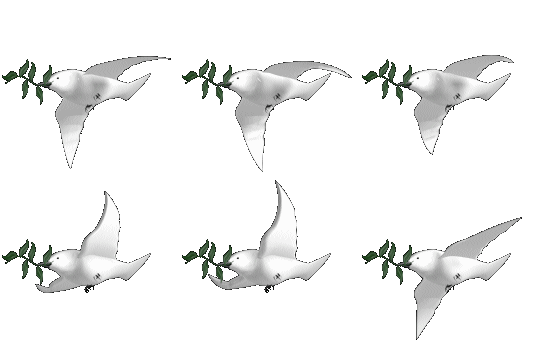
Help send a message of peace around the world! The Dove of Peace flies from site to site, through as many countries as possible. It does not belong to ANY belief system. Please help make a line around the globe by taking it with you to your site, by giving it to someone for their site, by passing it on to another continent or to the conflict areas of the world. May trouble and strife be vanquished in it's path.


mailto:George@controverscial.com
|
|